NOAA sends a robot crew into deep water off Hawaii
Three autonomous underwater vehicles put different styles of deep-sea mapping and sampling to the test from a single research ship.

NOAA's research ship Okeanos Explorer has had some extra crew off Hawaii this month. All three recruits go underwater without a tether, and the biggest is built for work at a depth of 6,000 meters. NOAA scheduled the trials from Nov. 2 through Nov. 16 to see how autonomous vehicles could fit into its regular ocean exploration.
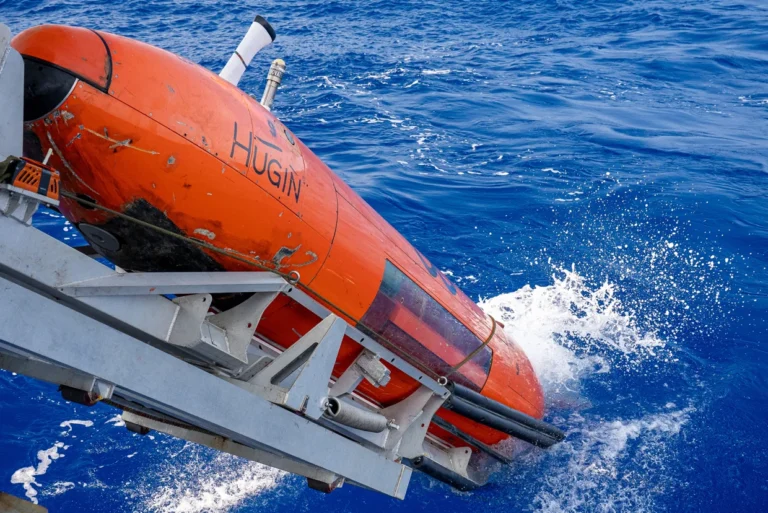
The biggest, a HUGIN 6000, carries sonar along with other instruments. NOAA describes it as the largest autonomous underwater vehicle yet brought aboard Okeanos Explorer and says it can operate for up to 48 hours. An expedition photograph shows it being launched from the ship. The two smaller Orpheus vehicles were equipped for close-up imaging and collecting sediment cores.
The combination addresses a practical gap. Ship-mounted sonar can map a large area, while a vehicle working nearer the seabed can record smaller features. In NOAA's operating plan, the HUGIN would follow planned survey tracks, while the Orpheus craft would examine selected spots with more detail.
The agency also planned to test the less glamorous parts of a successful robot outing. Crews need to calibrate equipment and learn how to launch and recover it from a moving ship. That's part of deciding whether a tool becomes routine equipment or remains a demonstration.
NOAA says the expedition could inform operations on Okeanos Explorer and its planned successor, Discoverer. The field plan describes what crews aimed to test. It does not establish that every planned run was completed.